When Is NVIDIA Jetson Orin the Right Fit for Your Project?
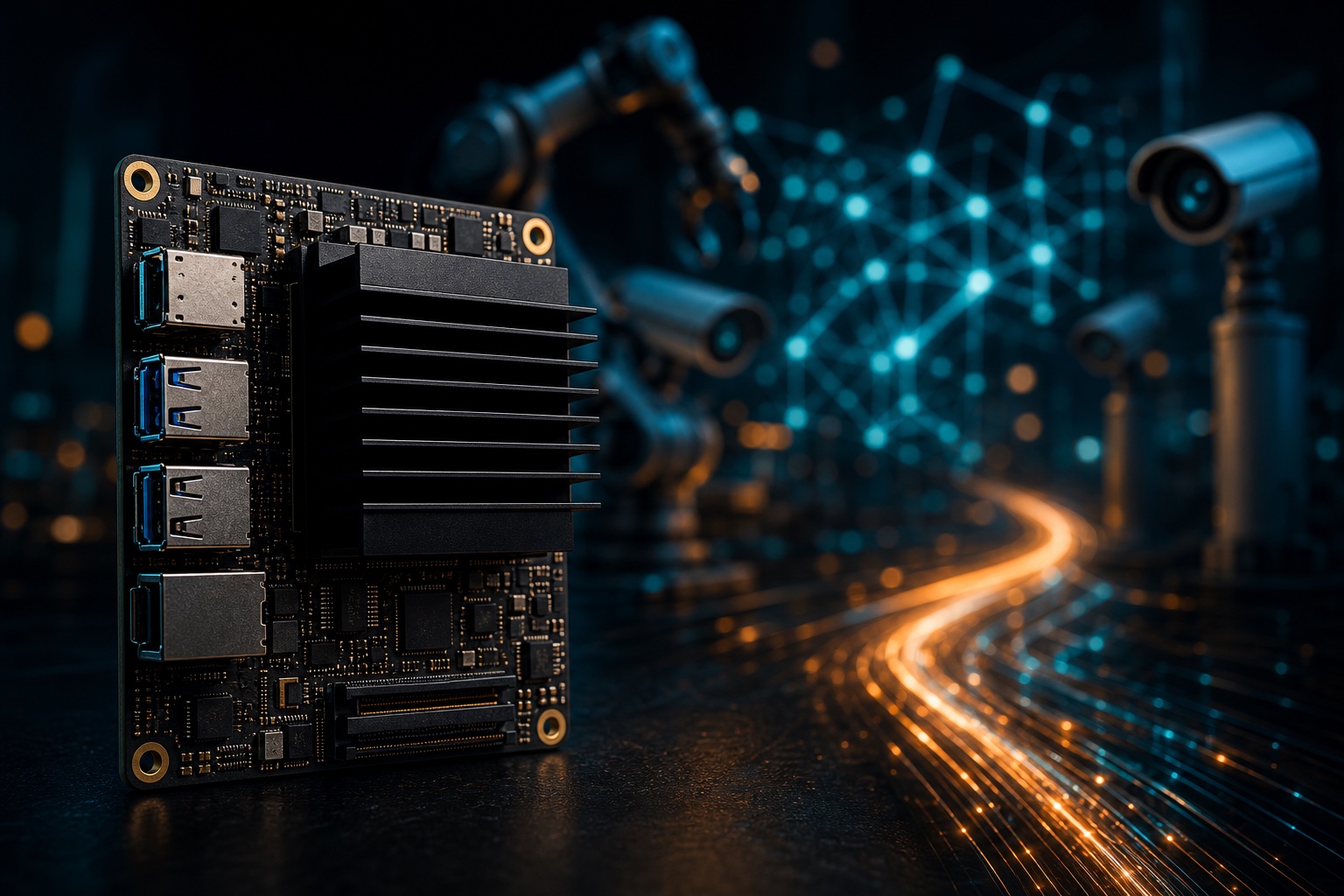
Jetson Orin is built for one job: running neural networks locally, at the edge. Vision models, sensor fusion, robotics, autonomous systems — anything where the AI must think on the device itself, not in the cloud. So the first question to ask is simple. Does your product need to run a neural network on the device?
If the answer is yes — because cloud latency is too high, because connectivity is not guaranteed, or because the data must stay private — then Orin becomes a real candidate. If the answer is no, and the device only runs a web server, reads a few sensors, or does light compute, then Orin is overkill. You would pay for a GPU you never use.
This article walks through what the platform is, how you move from prototype to product, when it becomes essential, where it hurts, and how it compares to the alternatives.
The Platform in Short
Orin is a family of small computers (modules) with an integrated NVIDIA GPU, CPU, and AI accelerators. One System-on-Chip architecture runs across the whole family, so a model built for one module runs on the others with little change. There are three tiers:
| Module | AI performance | Power | Memory | Typical role |
|---|---|---|---|---|
| Orin Nano | up to 67 TOPS | 7–25 W | 4 / 8 GB | Entry vision, smart cameras, light robotics |
| Orin NX | up to 157 TOPS | 10–40 W | 8 / 16 GB | Multi-camera analytics, drones, mobile robots |
| AGX Orin | up to 275 TOPS | 15–60 W | 32 / 64 GB | Autonomous machines, heavy sensor fusion |
The efficiency story matters for business. You choose a power mode — for example 15 W or 25 W on the Nano — and trade battery life against speed. This makes the same module usable in a plugged-in industrial box or a battery-powered robot. In late 2024 NVIDIA introduced Super Mode — a free software update (in JetPack) that unlocks higher GPU, CPU, and memory clocks across the Jetson Orin Nano and Orin NX modules, with no hardware change. On the Orin Nano it raised performance from 40 to 67 TOPS and memory bandwidth from 68 to 102 GB/s; the Orin NX gains up to about 70% more AI TOPS. NVIDIA also cut the Orin Nano developer kit price to $249. That is a strong signal: the entry point is now cheaper and faster than before.
Peripherals and cameras are where many projects live or die, so it is worth being concrete. Orin accepts cameras over three paths:
- MIPI CSI-2 — direct, low-latency camera connection. The Orin Nano carrier, for example, exposes two CSI connectors with four-lane support. Best image quality and timing, but you depend on a working driver for your exact sensor.
- USB (UVC / V4L2) — standard webcams and many industrial cameras. Easiest to get running.
- Network streams (RTSP / RTP / WebRTC) — existing IP and CCTV cameras over Ethernet. Ideal for retrofitting analytics onto cameras a customer already owns.
- Industrial machine-vision cameras — in industrial computer vision you also commonly use GigE Vision cameras over LAN and USB3 Vision cameras, driven through vendor SDKs or the GenICam/Aravis stack. These give the precise triggering, global shutter, and image quality that factory and inspection work demands.
These feed directly into NVIDIA’s DeepStream pipeline (more on that below), which runs many camera streams in parallel using the GPU and dedicated media and DLA (deep learning accelerator) blocks. For a video-analytics product, this multi-stream capability is often the deciding feature.
The Hidden Differentiator: NVDEC, NVENC, and NVJPEG
This is the point that decides many real projects and is easy to miss on a spec sheet. A neural network does not see a camera stream — it sees frames. Before any inference can happen, compressed video (H.264, H.265, AV1) has to be decoded into frames, and snapshots in JPEG have to be decompressed. After inference, results often have to be re-encoded for recording or for sending over the network. That work is heavy.
Orin does it on dedicated silicon, separate from the GPU and CPU:
- NVDEC — hardware video decoder (H.265, H.264, AV1, VP9).
- NVENC — hardware video encoder (H.265, H.264, AV1).
- NVJPEG — hardware JPEG decode and scaling.
Why this matters specifically at the edge, not only in a data center: an edge device has a tight budget for watts, heat, and board space. If decoding runs on the CPU, a single 4K stream can saturate the cores and leave nothing for the application; if it runs on the GPU, it steals the very cycles you wanted for inference. With NVDEC, decode is offloaded entirely, the GPU stays free for the neural network, many camera streams run in parallel, and power and temperature stay low. A pure AI accelerator — a Coral or a Hailo chip — does only the matrix math; it has no video engine, so a real camera product needs a second SoC just to decode and encode video. That adds cost, board complexity, and latency. On Jetson, one module does it all. For multi-camera products this integration is frequently the reason to choose Orin over a cheaper accelerator.
One important caveat to size correctly: the Orin Nano has no NVENC hardware encoder (it keeps NVDEC decode and NVJPEG). AGX Orin and Orin NX have the full set. So if your product needs to record or stream out encoded video at scale, the Nano will fall back to slower CPU/GPU encoding — and you may need to step up to Orin NX. (For a real-world encoder gotcha on Orin NX itself, see our deep dive on why nvv4l2h264enc fails inside Docker on Jetson Orin NX.)
A second, subtler caveat matters even more: these are fixed-function engines, so they support a specific list of codecs, profiles, bit depths, and chroma formats — not whatever a flexible CPU path could eventually handle. This bites hardest on the decode side (NVDEC and NVJPEG), because there you must accept whatever the source sends. You cannot assume a random HEVC stream will decode on NVDEC: a high-bit-depth or 4:2:2 professional camera feed, for example, can fall outside what the Ampere-generation decoder supports and then silently drop to a slow CPU path or fail outright. In other words, the decoder constrains your source equipment — the cameras and streams you are allowed to use. On the encode side it is easier, because you control the output format. The practical rule: validate the entire media path end-to-end against the exact source hardware before you commit, since the camera or stream format can limit your platform choice as much as the AI model does. Note too that fixed-function engines carry format restrictions a CPU-based path may not — for example how NVDEC handles HDR video — so plan the media path and edge hardware components end to end before you commit to a module.
DeepStream — and a Friendlier Path with Savant
DeepStream is NVIDIA’s SDK for building real-time, GPU-accelerated video-analytics pipelines. It chains the whole flow — ingest many streams (RTSP/USB/CSI/file), decode on NVDEC, batch the frames, run inference with TensorRT, track objects across frames, and output results or re-encoded video — while keeping the data on the GPU the entire time, so there are no costly copies back and forth to the CPU. The payoff is concrete: a single Orin module can analyze many HD or 4K camera streams at once with low latency and low power. For a smart-city, retail, or industrial-inspection product, that throughput is the core of the value.
The honest trade-off is that DeepStream is a low-level, complex SDK built on GStreamer; the learning curve is real and development can be slow. A friendly alternative is Savant, an open-source Python framework built on top of DeepStream that hides its complexity. You declare the pipeline in YAML and write your logic in plain Python, run inference primarily through TensorRT (which is what both DeepStream and Savant are built on) with PyTorch available on the GPU as a fallback for models TensorRT cannot yet handle, run the identical pipeline on both Jetson and data-center GPUs in Docker, and use a development server that hot-reloads code without restarting the pipeline. For teams who want DeepStream’s performance without its steep ramp-up, Savant is a strong option worth evaluating early — and if you are weighing the two, see our breakdown of Savant vs. DeepStream: what to use, when, and why.
Developer Kits vs. Embedded Production Modules
This distinction trips up many teams and has direct budget and risk consequences.
A developer kit is for the lab. It typically runs from an SD card or an NVMe SSD, the materials are not production grade, components can change without notice, and NVIDIA explicitly says it is not for field deployment. It is cheap, fast to start, and perfect for proving your idea.
A production module is the real product part. It has soldered eMMC storage, ships with no software (you flash your own validated image), carries a rated operating lifetime, and mounts onto a carrier board designed for your enclosure, connectors, and environment. Commercial Orin modules are rated for a five-year operating life; the AGX Orin Industrial version is validated for ten years and harsh conditions.
The practical takeaway: prototype on a dev kit, but plan from day one that the shipping product uses a production module on a custom or partner carrier board. The pinout and storage differ, so this is a real engineering step, not a swap. A large ecosystem of NVIDIA partners (Connect Tech, Advantech, and others) sells off-the-shelf carrier boards, which can save months versus designing your own.
From Research to Production: The CUDA Advantage
This is the strongest commercial reason to choose Orin, and it is easy to undervalue. Orin runs the same CUDA software stack as NVIDIA’s data-center GPUs. So the normal workflow is:
- Train and prototype on a desktop or cloud NVIDIA GPU, where you can be messy and iterate fast.
- Export the model to ONNX.
- Optimize it with TensorRT into a fast inference engine.
- Deploy that engine on Orin with minimal code changes.
Your data scientists keep their familiar tools (PyTorch, TensorFlow, CUDA), and the path to the edge is short. Most other edge accelerators force a separate compilation toolchain and a different mental model, which adds engineering time and risk. With Orin, the team you already have can usually carry a model from research to a shipping device.
One caveat to plan for: the optimized TensorRT engine (a .plan file) is locked to a specific JetPack, CUDA, and GPU version. If you upgrade the system software or change the module, you rebuild the engine. The model is portable; the compiled engine is not.
Maturity of the Stack and Tools
Orin sits on JetPack, NVIDIA’s bundle of a Linux OS (Ubuntu-based), CUDA, cuDNN, TensorRT, and multimedia and computer-vision libraries. On top of that are mature higher-level SDKs: DeepStream for video analytics, Isaac ROS for robotics, and Riva for speech. There is extensive documentation, an active developer forum, tutorials through Jetson AI Lab, and a community of millions of developers on the robotics stack.
For a business, maturity reduces risk. You are unlikely to hit a problem nobody has solved before, hiring engineers who know CUDA is realistic, and the tooling connects cleanly to NVIDIA’s training and simulation ecosystem. This depth is Orin’s biggest moat over cheaper rivals.
The Production OS: Upgrades, Ubuntu, Red Hat, and Yocto
A point that catches teams late: the friendly developer experience does not always carry over to a production module on a custom carrier board, and you must plan the operating-system and upgrade strategy deliberately.
Upgrades are not automatic. On a custom or partner carrier board, the system software depends on a Board Support Package (BSP) that the carrier vendor maintains — it is what makes JetPack actually run with your camera sensors and connectors. You usually cannot just take the newest stock JetPack over the air; the vendor has to port and validate a new BSP for that JetPack release first. In practice many fielded modules rely on a custom upgrade mechanism (often a vendor or in-house over-the-air system), and some stay on an older JetPack because moving to the latest NVIDIA system software is not supported on their board. Decide early who owns upgrades, and confirm with your carrier-board vendor how far forward they will track JetPack.
You are also not limited to NVIDIA’s default Ubuntu image. Several production-grade OS paths now exist:
- Canonical Ubuntu. Canonical now officially supports Ubuntu on Jetson Orin modules, with optimized images and long-term security maintenance. For hardened products, Ubuntu Core offers a minimal, containerized OS with strict confinement and reliable over-the-air updates — a common choice for commercial IoT fleets.
- Red Hat Device Edge. Red Hat brings RHEL plus its MicroShift (lightweight Kubernetes) and fleet management to Jetson Orin. This is attractive for enterprises standardized on Red Hat, though note that, at the time of writing, Jetson Orin support is Tech Preview — not yet positioned for production.
- Yocto / OpenEmbedded. For a fully custom, reproducible, minimal image, the community meta-tegra layer (OE4T) builds Jetson Linux with Yocto, and from JetPack 7.2 NVIDIA supports Yocto on Jetson officially. This is the route for tightly controlled embedded products where you need to own every package in the image — at the cost of more build engineering.
The takeaway for a business: budget for OS and lifecycle ownership as a real workstream, and choose the OS path (NVIDIA Ubuntu, Canonical, Red Hat, or Yocto) that matches your security, fleet-management, and long-term-support needs.
When Jetson Orin Becomes Essential
Orin is the right fit — sometimes the only sensible fit — when one or more of these requirements is real:
- Technical: latency and real-time control. Robots, drones, and machines that must react in milliseconds cannot wait for a cloud round trip. Local inference (single-digit millisecond latency is achievable) is mandatory.
- Technical: offline operation. Agriculture, mining, maritime, defense, and remote infrastructure cannot rely on connectivity. The intelligence must live on the device.
- Ethical and privacy. Cameras in hospitals, schools, or workplaces raise real concerns. Processing video on-device and sending out only results (not raw footage) is a strong privacy posture and easier to justify to stakeholders.
- Security and data residency. Keeping sensitive data on the device reduces the attack surface and helps meet regulations (such as GDPR-style data-residency rules) that restrict moving data off-site.
- Commercial: lifecycle and reuse. Multi-year product availability, a single architecture across price tiers, and reuse of existing NVIDIA skills lower the total cost of owning the platform over a product’s life.
- Commercial: a CAPEX-first business model. Some vendors deliberately prefer their customers to buy equipment (CAPEX) rather than pay recurring compute or service fees (OPEX). Edge inference fits this model cleanly: the AI compute ships inside the device the customer owns, so there is no metered cloud bill for the vendor to carry or pass on. Even when the market is willing to spend on CAPEX, Jetson stays attractive here — it is an off-the-shelf module with no custom-silicon engineering cost (no NRE), so it is economical even at low volumes, where a bespoke ASIC would never pay back. For specialized, low-volume products where you want the customer to own the hardware, Orin is often the most sensible option.
If none of these apply — the device is online, latency-tolerant, and handles no sensitive data — a cloud API or a much cheaper chip is the better business decision.
Caveats and Known Difficulties
Being honest about the rough edges protects the schedule:
- Steep learning curve. Flashing, JetPack versions, and Linux setup demand real embedded-Linux skill. It is not plug-and-play. Budget time for the first boot-to-working-demo.
- Thermal management. The GPU throttles when the chip passes about 80 °C, and dev-kit fans default to a quiet mode. Sustained performance needs proper cooling designed into the enclosure — a frequent surprise in the field.
- Camera and driver friction. CSI cameras need a matching driver; non-standard sensors and third-party carrier boards can mean porting work or vendor support tickets. USB/UVC cameras are far easier if you have the choice.
- Version coupling and upgrades. SDKs, drivers, and TensorRT engines are tied to JetPack versions, so upgrades can break things and need re-testing. On a custom carrier board you also depend on the vendor’s BSP, so moving to the newest JetPack is not always possible (see the production-OS section above).
- Cost and power. Orin costs more and draws more power (roughly 10–25 W plus peripherals for the smaller modules) than minimal accelerators. If your model is small, you are overpaying.
“It Is Not a Small PC”: Where Embedded Bites You
The single most expensive misconception is treating Jetson like a tiny desktop — install, run, ship. An embedded device lives in a harsh world of power cuts, heat, vibration, and years of unattended operation, and the habits that work on a PC quietly cause field failures. Good practice closes that gap; ignoring it bites you after deployment, when fixing it is most costly.
The recurring traps:
- Storage and power loss. Developer setups often run from an SD card, though Orin dev kits can also boot from an NVMe SSD. The medium matters less than the discipline: in the field, any storage plus a sudden power cut is a recipe for a corrupted filesystem and a dead device. Production designs use industrial eMMC or NVMe, a read-only or carefully managed root filesystem, and a graceful-shutdown or power-fail strategy. Heavy logging also wears out flash over time — a PC habit that kills an embedded device after a year.
- Thermal is a design task, not an afterthought. On a bench the board is cool; sealed in an enclosure on a hot factory floor, it throttles at about 80 °C and your “benchmarked” performance disappears. Sustained AI load usually needs active cooling engineered for the worst-case ambient, not a default fan.
- Performance must be engineered. You do not get full speed for free. You select the right power mode, pin the clocks (
jetson_clocks), watch the system withtegrastats/jtop, and optimize models through TensorRT. Skip this and the device feels mysteriously slow. - Memory is shared and finite. CPU and GPU share one memory pool, and there is little or no swap. A model that fit comfortably on a workstation can trigger out-of-memory kills on the module. You must size the model to the board.
- You cannot just
apt upgradethe kernel. Drivers and the OS are tied to the BSP and JetPack, as covered above. PC-style “update everything” can break the board.
None of this is a reason to avoid Jetson. It is a reason to staff and schedule it as an embedded project — with environmental testing, a deployment image, and a power and thermal plan — rather than as a software project that happens to run on small hardware.
The Support Question: NVIDIA’s Approach and How Others Differ
Buyers should go in clear-eyed about how support works, because it is different from enterprise software. NVIDIA’s primary support channel for Jetson is self-service and community: extensive documentation, the Jetson AI Lab, and the very active NVIDIA Developer Forums. This is a real strength — most problems have been hit and solved by someone already. But it has a flip side: forum answers can be slow or uneven, documentation sometimes lags or has broken links, and there is no hand-holding hotline that walks an individual product team through a custom bring-up. For a company on a deadline, “post and wait” is not a support contract.
The way this gap gets filled is through NVIDIA’s partner ecosystem rather than NVIDIA directly. Elite partners such as Connect Tech (carrier boards), RidgeRun (BSP, multimedia, and Yocto engineering), Advantech, and others sell commercial, paid engineering support — they will port your BSP, bring up your cameras, and back your product with an SLA. The practical lesson: for a serious deployment, budget for a hardware/BSP partner as part of the project, and do not assume NVIDIA will provide that service itself.
How do other vendors deal with it? Smaller-ecosystem players (for example Hailo or Qualcomm-based platforms) often provide more direct field-application-engineer (FAE) support and closer hand-holding, because their customer base is narrower and the relationship is more direct — but you get a much smaller community and fewer ready-made answers when you hit something obscure. So the trade-off is real: with Jetson you get the largest community and a deep paid-partner market but limited direct support from the chip vendor; with a smaller platform you may get more personal vendor attention but a thinner ecosystem to lean on. Neither is strictly better — match it to whether your team prefers self-reliance plus a partner, or a closer line to the silicon vendor.
Competing Platforms
Orin is not always the answer. The main alternatives:
- Google Coral (Edge TPU) — about 4 TOPS at ~2 W, very cheap and very efficient, and excellent at lightweight INT8 vision models (running MobileNet at hundreds of frames per second). But it is limited to a narrow set of quantized models and a restrictive toolchain. Good for a single fixed model on a low-power sensor; weak for flexible or heavy workloads.
- Hailo-8 — about 26 TOPS at ~2.5 W, class-leading efficiency (~10 TOPS/W), strong for running several HD video streams on a tight power budget. The trade-off is a specialized compiler: you cannot run raw PyTorch, and it is optimized mainly for vision inference. Great as an efficient vision accelerator, less so for general or research-style workloads.
- Rockchip (RK3588 and newer) — a 6 TOPS NPU in a low-cost SoC, a practical pick for many embedded consumer products where budget rules and the model is modest.
- Qualcomm (Robotics platforms) — around 15 TOPS with integrated 5G, attractive when cellular connectivity and mobile power efficiency matter together.
A key industry insight cuts across all of this: many industrial vision applications only need 10–20 TOPS. Chasing the highest TOPS adds cost, power, and complexity for no real benefit. Choose the platform that matches the workload, not the biggest number.
It is also worth knowing where Orin sits in NVIDIA’s own line. In 2025 NVIDIA launched Jetson Thor (Blackwell-based), the successor aimed at heavy generative AI and humanoid robotics — roughly 7.5× Orin’s compute, but starting at $3,499 for the dev kit. For the large majority of edge-AI products, Orin remains the mainstream, cost-effective choice; Thor is for the demanding frontier.
The Bottom Line
Choose Jetson Orin when your product must run real neural networks on the device, when latency, offline operation, privacy, or security rule out the cloud, and when you value being able to carry models from your data-center GPUs to the edge with the same tools and a multi-year supply commitment. Within the family, start with the Orin Nano for vision and light robotics, step up to Orin NX for multi-camera or mobile robots, and reserve AGX Orin for autonomous machines and heavy sensor fusion.
Avoid it when the workload is light, the device is reliably online, and no sensitive data is involved — there, a cloud service or a cheaper accelerator like Coral, Hailo, or Rockchip will serve you better and cheaper. Match the platform to the requirement, prototype on a dev kit, and plan the move to a production module before you commit to ship.
Sources
- Jetson AGX Orin for Next-Gen Robotics — NVIDIA
- Jetson Modules, Support, Ecosystem, and Lineup — NVIDIA Developer
- Jetson Orin Nano Super Developer Kit — NVIDIA
- NVIDIA launches new $249 AI development board (67 TOPS) — Tom’s Hardware
- Taking Your First Picture with CSI or USB Camera — NVIDIA Developer
- Using the Jetson Orin Nano with CSI Cameras — JetsonHacks
- Building a Multi-Camera Media Server for AI Processing on Jetson — NVIDIA Technical Blog
- Difference between Jetson Dev Kit Module & Production Module — NVIDIA Developer Forums
- Jetson FAQ — NVIDIA Developer
- Jetson Product Lifecycle — NVIDIA Developer
- NVIDIA Jetson Product Lifecycle: What You Need to Know — BVM Ltd
- JetPack Software Stack for NVIDIA Jetson — NVIDIA Developer
- TensorRT SDK — NVIDIA Developer
- Breaking Free from the CUDA Lock-in — Edge AI and Vision Alliance
- Hailo vs NVIDIA Jetson Orin: Which Edge AI Solution Fits Your Project? — Peila International
- Edge-AI Accelerators (Jetson vs Coral TPU) — ThinkRobotics
- How to Choose the Best Edge AI Platform: Jetson, Kria, Coral and Others — Promwad
- Jetson Orin Nano Developer Kit Issues and Solutions — Piveral
- NVIDIA Blackwell-Powered Jetson Thor Now Available — NVIDIA Newsroom
- NVIDIA Jetson AGX Orin Series Technical Brief (NVDEC/NVENC/NVJPEG) — NVIDIA
- Jetson Orin Nano: Real-time Performance for Video Encoding (no NVENC) — RidgeRun
- Why Offloading Video Decode to Integrated GPUs Matters for Edge AI — make87
- DeepStream SDK — NVIDIA Developer
- Savant: Python Computer Vision & Video Analytics Framework — GitHub / savant-ai.io
- Ubuntu now officially supports NVIDIA Jetson — Canonical
- Red Hat Device Edge now available to run on NVIDIA Jetson Orin — Red Hat
- OE4T/meta-tegra: Yocto/OpenEmbedded BSP layer for Jetson — GitHub
- JetPack 7.2 and Yocto: A Production Deployment Milestone — Connect Tech
- NVIDIA Jetson Software Support and Integrations — RidgeRun
- NVIDIA Developer Forums (Jetson community support)
- NVIDIA Jetson Thermal Design Guide — Things Embedded UK
- Power Optimization with NVIDIA Jetson — NVIDIA Technical Blog